info@chrischambers-som.com
 07951 047 894

Embarking on the personal journey of learning to drive requires a self-made decision and commitment. The decision to learn should be your own; it shouldn't be influenced by others. If you're learning to drive because someone else wants you to, you're doing it for the wrong reasons, as you'll be the one putting in the work and finding the motivation.
Below is a list of frequently asked questions. If you have a question not listed, please feel free to contact me; I'd be happy to help.
- Why might learning to drive and obtaining a driving licence be advantageous?
- What steps are necessary before I can begin driving?
- When may I begin taking driving lessons?
- How often should I schedule a lesson?
- How many driving lessons will I require?
- Would it be possible for me to drive during my initial lesson?
- What are the elements involved in both the Theory and Practical tests?
- Could you assist with the Theory and Hazard Perception Test?
- Do you offer intensive training courses, sometimes referred to as "crash courses"?
- Would it be possible to receive instruction for automatic transmission vehicles?
- Is your training vehicle equipped with dual controls?
- Is it true that driving test examiners have a weekly pass quota?
- Is passing on the first attempt guaranteed with Chris Chambers School of Motoring?
- As a learner driver, may I enquire about the permissibility of driving on motorways?
- What payment methods do you accept for driving lessons?
A full driving licence offers independence, expands employment prospects, and imparts a valuable life skill. However, becoming a safe and proficient driver requires a time and financial commitment, especially when using a reputable driving instructor, which can be costly. Despite this, the freedom and opportunities a licence provides are invaluable.
If you choose to learn, consider it a worthwhile investment in your future.
You must first obtain a UK provisional driving licence. This can be done online at www.gov.uk for £34.00, or by completing form D1, available at your local Post Office, for £43.00.
You must be at least 17 years old, although this is reduced to 16 if you receive, or have applied for, the higher rate of the mobility component of Personal Independence Payment (PIP). You can apply for a provisional driving licence up to three months before your 17th birthday.
The frequency of your lessons depends on your personal preferences and learning goals. Consider your available time and budget when making this decision. For consistent progress, regular lessons are recommended. I suggest at least one two-hour session per week, although we offer both half-day and full-day options. Many students find two two-hour sessions per week optimal, allowing for reflection without feeling overwhelmed. This approach often leads to faster, more comfortable learning. More frequent lessons can save time and potentially reduce overall costs.
Whether you choose one lesson per week or two, each lesson will be carefully structured, expertly delivered, and will have clear, achievable goals.
It's unfortunately impossible to give a precise answer, as everyone's learning speed varies due to individual strengths, weaknesses, prior experience, and natural aptitude. A Government survey suggest an average of 52 hours of professional instruction plus 24 hours of supervised practice to pass the UK driving test, but this is just an average; some individuals need fewer lessons, while others may need more.
I would politely suggest that you exercise caution when considering the learning experiences of others, as their timelines may not accurately reflect your learning process. I frequently hear from clients about relatives who passed their driving test in a short time many years ago. While I cannot dispute these accounts, it's important to remember that road conditions, traffic volume, vehicle technology, and driving standards have evolved significantly. Many experienced drivers from that era might struggle to pass today's test without additional training. I often speak with parents who readily acknowledge they would find the current driving test challenging.
Additionally, I often hear from clients about friends who passed their driving test after minimal professional instruction. However, achieving the required proficiency in such a short timeframe, while not entirely impossible, is improbable for most individuals, especially those without prior driving experience. Although I cannot verify these claims, they may be somewhat exaggerated.
From my perspective as a seasoned and respected driving instructor, I wouldn't recommend any new driver for a test after such minimal road experience. Ten hours is insufficient to develop the necessary skills, knowledge, and understanding. I believe it would be irresponsible to present a driver with such limited experience for testing; driving is a safety-critical activity requiring substantial practice.
While accompanied private practice is helpful, many learners lack access to a vehicle outside lessons. This shouldn't hinder progress. If you do have access to a vehicle, it's best to practice previously learned skills, reserving new skill acquisition for professional lessons.
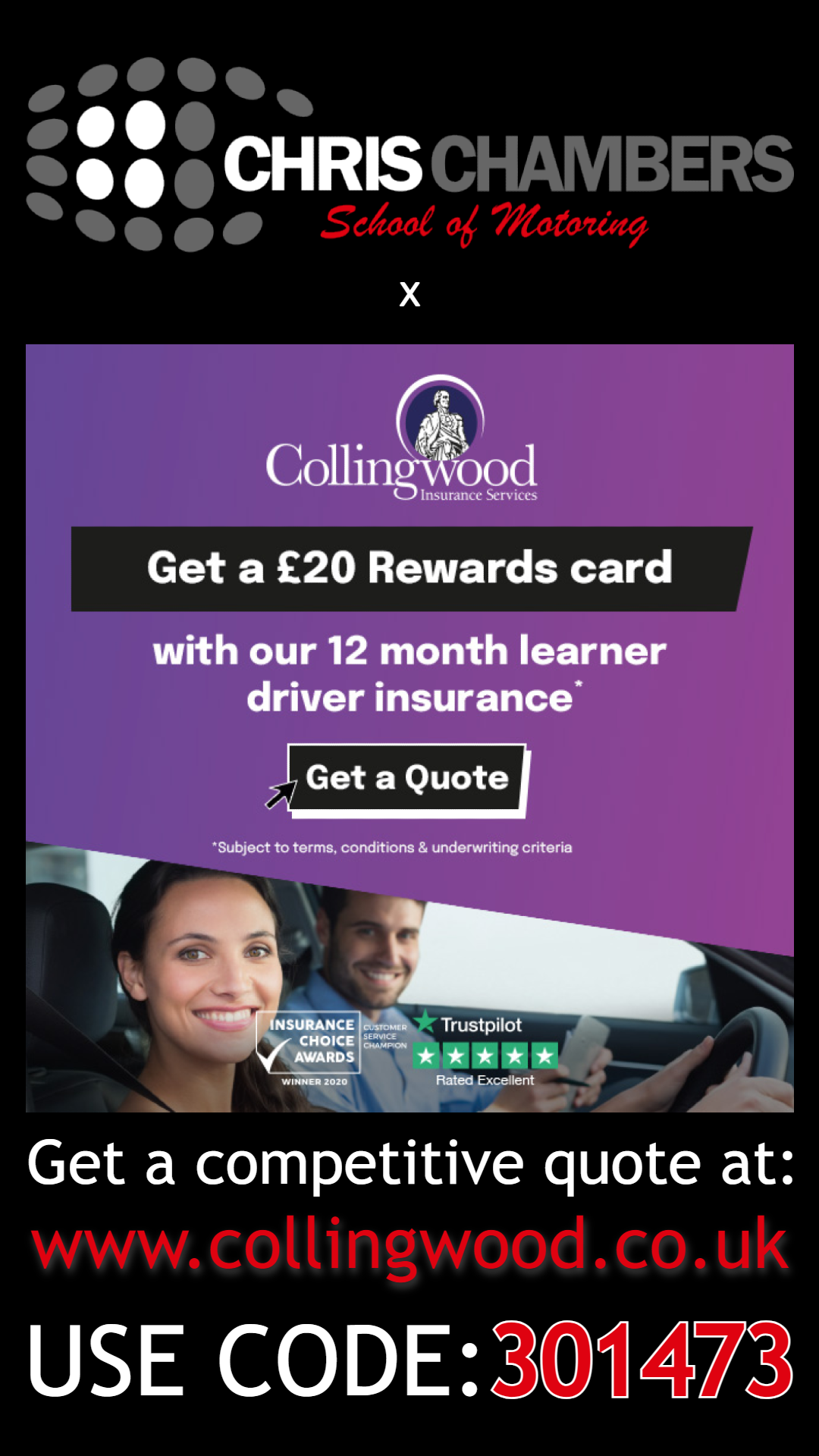
Chris Chambers School of Motoring, in partnership with Collingwood Insurance Services UK Ltd (use code 301473 to unlock rewards), Adrian Flux Insurance Services (use code i1213 to unlock rewards), and Think Insurance Services Ltd Insurance (use code 489 to unlock rewards), offers short-term learner driver insurance policies ranging from 7 days to 24 weeks. These policies cover driving your own vehicle or someone else's (as specified; terms and conditions apply). This dedicated learner driver insurance allows for the necessary private practice, providing the protection you need.
Please note that standard rules and requirements for supervising a provisional licence holder still apply.
Yes, absolutely! Although there will be a significant amount to learn, you will have the chance to operate the training vehicle during your first lesson.
For comprehensive details, please consult the sections on the 'Theory Test' and 'Practical Test' pages.
Certainly. I would be delighted to help elucidate any questions you find difficult. I can also recommend helpful books, applications, and websites to support your preparation.
In the strictest sense of what is generally considered intensive, no. I harbour some reservations regarding their effectiveness, as I believe they might create a misleading impression. The conventional structure of such courses often fosters unrealistic expectations and places excessive demands on students within a limited timeframe. This method, in my opinion, is not conducive to acquiring a life skill such as driving, which should not be undertaken hastily. Moreover, intensive courses lack standardisation; their duration can vary significantly, ranging from a week to several months.
Please do not hesitate to contact me to discuss your requirements.
I am sorry to say that I presently only provide instruction for manual transmission vehicles. Kindly note that completing your driving test in a manual vehicle will enable you to operate automatic vehicles as well. Conversely, passing the test in an automatic vehicle will limit you to driving only automatics; an additional driving test would be required to gain the ability to drive manual vehicles at a later date.
Yes, top quality “He-Man” dual controls have been professionally installed in the training vehicle for your safety and peace of mind.
No, that is completely untrue. A pass is solely dependent on your performance during the test.
No, unfortunately, that cannot be guaranteed. All practical tests are conducted by DVSA (Driver and Vehicle Standards Agency) examiners, and candidates are assessed individually. Factors like nerves can affect performance, even for well-prepared candidates.
Yes, learner drivers are permitted to receive driving instruction on motorways in England, Scotland, and Wales, provided they are accompanied by a qualified, DVSA Approved Driving Instructor and the vehicle is equipped with dual controls. It is important to note that motorway driving is not currently a component of the driving test; therefore, any such lessons are entirely voluntary and at the instructor's discretion regarding the learner's readiness.
Chris Chambers School of Motoring accepts payment via bank transfer.

The factual information contained within this page is, to the date of posting, correct to the best of my knowledge. No liability is accepted for errors or omissions.
*Please note that in the interests of both safety and law, I am unable to answer calls or respond to messages whilst conducting driver training sessions. Should your enquiry not be answered swiftly, please leave your name and a brief message (for private/withheld numbers, please leave a contact number within your voice message also) and I will contact you at my earliest possible opportunity; your enquiry is extremely important to me. Calling or texting/WhatsApp is generally the preferred method of contact as I can respond to your enquiry more quickly and efficiently.
An answer phone messaging service is available at all times (24 hours).